Technology

present software technlogies


 The two most important phenomena impacting telecommunications over the past decade have been explosive parallel growth of both the internet and mobile telephone services. The internet brought the benefits of data communications to the masses with email, the web, and ecommerce; while mobile service has enabled "follow-me anywhere/always on" telephony. The internet helped accelerate the trend from voice-centric to data-centric networking. Data already exceeds voice traffic and the data share continues to grow. Now these two worlds are converging. This convergence offers the benefits of new interactive multimedia services coupled to the flexibility and mobility of wireless. To realize the full potential of this convergence, however, we need broadband access connections.

Here we compare and contrast two technologies that are likely to play important roles: Third Generation mobile ("3G") and Wireless Local Area Networks ("WLAN") . The former represents a natural evolution and extension of the business models of existing mobile providers. In contrast, the WiFi approach would leverage the large installed base of WLAN infrastructure already in place. We use 3G and WiFi as shorthand for the broad classes of related technologies that have two quiet distinct industry origins and histories.

Speaking broadly, 3G offers a vertically -integrated , top -down , service - provider approach to delivering wireless internet access , while WiFi offers an end -user -centric , decentralized approach to service provisioning. We use these two technologies to focus our speculations on the potential tensions between these two alternative world views. The wireless future will include a mix of heterogenous wireless access technologies. Moreover, we expect that the two world views will converge such that vertically-integrated service providers will integrate WiFi or other WLAN technologies into their 3G or wire line infrastructure when this make sense. The multiplicity of potential wireless access technologies and /or business models provided some hope that we may be able to realize robust facilities - based competition for broadband local access services. If this occurs, it would help solve the "last mile" competition problem that has been deviled telecommunication policy.

SOME BACKGROUND ON WiFi AND 3G

3G:
3G is a technology for mobile service providers. Mobile services are provided by service providers that own and operate their own wireless networks and sell mobile services to and -users. Mobile service providers use licensed spectrum to provide wireless telephone coverage over some relatively large contiguous geographic service area. Today it may include the entire country. From a user's perspective, the key feature of mobile service is that it offers ubiquitous and continuous coverage. To support the service, mobile operators maintain a network of interconnected and overlapping mobile base stations that hand-off customers as those customers move among adjacent cells. Each mobile base station may support user's upto several kilometers away. The cell towers are connected to each other by a backhaul network that also provides interconnection to the wire line Public Switched Telecommunications Network (PSTN) and other services. The mobile system operator owns the end-to-end network from the base stations to the backhaul networks to the point of interconnection to the PSTN. Third
Generations (3G) mobile technologies will support higher bandwidth digital communications. To expand the range and capability of data services that can be supported by digital mobile systems, service providers will have to upgrade their networks to one of the 3G technologies which can support data rates of from 384Kbps up to 2Mbps.

WiFi
WiFi is the popular name for the wireless Ethernet 802.11b standard for WLANs . WiFi allows collections of PCs, terminals ,and other distributed computing devices to share resources and peripherals such as printers, access servers etc. One of the most popular LAN technologies was Ethernet.

HOW ARE WiFi AND 3G SAME
From the preceding discussion, it might appear that 3G and WiFi address completely different user needs in quiet distinct markets that do not overlap. While this was certainly more true about earlier generations of mobile services when compared with wired LANs or earlier versions of WLANs , it is increasingly not the case. The end- user does not care what technology is used to support his service. What matter is that both of these technologies are providing platforms for wireless access to the internet and other communication services.

Mobile positioning technology has become an important area of research, for emergency as well as for commercial services. Mobile positioning in cellular networks will provide several services such as, locating stolen mobiles, emergency calls, different billing tariffs depending on where the call is originated, and methods to predict the user movement inside a region. The evolution to location-dependent services and applications in wireless systems continues to require the development of more accurate and reliable mobile positioning technologies. The major challenge to accurate location estimation is in creating techniques that yield acceptable performance when the direct path from the transmitter to the receiver is intermittently blocked. This is the Non-Line-Of-Sight (NLOS) problem, and it is known to be a major source of error since it systematically causes mobile to appear farther away from the base station (BS) than it actually is, thereby increasing the positioning error.

NEED FOR MOBILE TRACKING

Recent demands from new applications require positioning capabilities of mobile telephones or other devices. The ability to obtain the geo-location of the Mobile Telephone (MT) in the cellular system allows the network operators to facilitate new services to the mobile users. The most immediate motivation for the cellular system to provide MT position is enhanced in accident emergency services. The positioning of the mobile user could provide services like

¢ Emergency service for subscriber safety.
¢ Location sensitive billing.
¢ Cellular Fraud detection.
¢ Intelligent transport system services.
¢ Efficient and effective network performance and management.

Location Tracking Curve Method
The method proposed by us for tracking the location of a mobile telephone using curves connecting the points where circles intersect one another, the circles radii being the distances between BSs and the mobile                                                                     telephone. The steps involved are:

a. Each base station nearer to a mobile telephone receives a predetermined signal from the mobile telephone and calculates the distance between the mobile telephone and the base station and the variances of time arrival of the signal at the base station;
b. A circle is drawn to have a radius being the distance and the coordinates of the base station being the center of the circle;
c. A pair of the first and the second base stations is selected among the base stations. A several location tracking curves connecting two intersection points between the selected circles corresponding to the first and the second base stations are drawn. One of the location tracking curves is selected using the variances of the first and the second base stations;
d. The steps c. and d. are repeated for the other pairs of the base stations;
e. The intersection points are obtained among the location tracking curves selected in step d. and e. and,
f. The location of the mobile telephone is determined using the coordinates of the intersection points obtained in step e.

The several location tracking curves are parts of circles with centers near to the base station with smaller variances between the first and the second base stations. The circles formed by the location tracking curves have the centers on a line connecting the coordinates of the first and the second base stations. The larger variances between the variances of the first and the second base stations are compared to the variances of the several location tracking curves, and one of the location tracking curves is selected according to the comparison result. The location coordinates of the mobile telephone are determined by averaging the coordinates of the intersection points obtained in step (f).

Definition
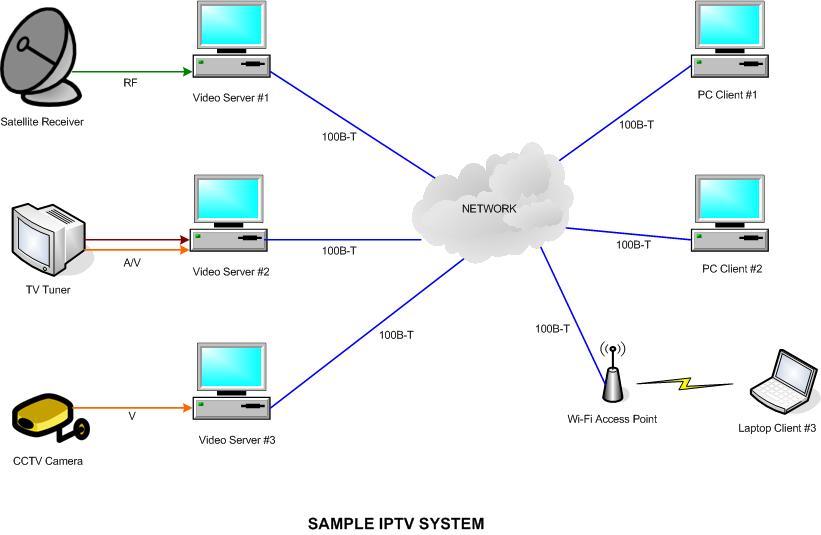
Over the last decade, the growth of satellite service, the rise of digital cable, and the birth of HDTV have all left their mark on the television landscape. Now, a new delivery method threatens to shake things up even more powerfully. Internet Protocol Television (IPTV) has arrived, and backed by the deep pockets of the telecommunications industry, it's poised to offer more interactivity and bring a hefty dose of competition to the business of selling TV.

IPTV describes a system capable of receiving and displaying a video stream encoded as a series of Internet Protocol packets. If you've ever watched a video clip on your computer, you've used an IPTV system in its broadest sense. When most people discuss IPTV, though, they're talking about watching traditional channels on your television, where people demand a smooth, high-resolution, lag-free picture, and it's the Telco's that are jumping headfirst into this market. Once known only as phone companies, the Telco's now want to turn a "triple play" of voice, data, and video that will retire the side and put them securely in the batter's box. In this primer, we'll explain how IPTV works and what the future holds for the technology. Though IP can (and will) be used to deliver video over all sorts of networks, including cable systems.
How It Works

First things first: the venerable set-top box, on its way out in the cable world, will make resurgence in IPTV systems. The box will connect to the home DSL line and is responsible for reassembling the packets into a coherent video stream and then decoding the contents. Your computer could do the same job, but most people still don't have an always-on PC sitting beside the TV, so the box will make a comeback. Where will the box pull its picture from? To answer that question, let's start at the source.

Most video enters the system at the Telco's national head end, where network feeds are pulled from satellites and encoded if necessary (often in MPEG-2, though H.264 and Windows Media are also possibilities). The video stream is broken up into IP packets and dumped into the Telco's core network, which is a massive IP network that handles all sorts of other traffic (data, voice, etc.) in addition to the video. Here the advantages of owning the entire network from stem to stern (as the Telco's do) really come into play, since quality of service (QoS) tools can prioritize the video traffic to prevent delay or fragmentation of the signal. Without control of the network, this would be dicey, since QoS requests are not often recognized between operators. With end-to-end control, the Telco's can guarantee enough bandwidth for their signal at all times, which is key to providing the "just works" reliability consumers have come to expect from their television sets.

The video streams are received by a local office, which has the job of getting them out to the folks on the couch. This office is the place that local content (such as TV stations, advertising, and video on demand) is added to the mix, but it's also the spot where the IPTV middleware is housed. This software stack handles user authentication, channel change requests, billing, VoD requests, etc.-basically, all of the boring but necessary infrastructure.

All the channels in the lineup are multicast from the national headend to local offices at the same time, but at the local office, a bottleneck becomes apparent. That bottleneck is the local DSL loop, which has nowhere near the capacity to stream all of the channels at once. Cable systems can do this, since their bandwidth can be in the neighborhood of 4.5Gbps, but even the newest ADSL2+ technology tops out at around 25Mbps (and this speed drops quickly as distance from the DSLAM [DSL Access Multiplier] grows).

Custom Search

visitors in world